FREE SHIPPING ON ORDERS OVER $300

$190.00
Amino Acid Sequence:
Met‑Arg‑Trp‑Gln‑Glu‑Met‑Gly‑Tyr‑Ile‑Phe‑Tyr‑Pro‑Arg‑Lys‑Leu‑Arg
Chemical Formula:
C₁₀₁H₁₅₂N₂₈O₂₂S₂
CAS Registry Number:
1627580‑64‑6
Metabolic regulation (insulin sensitivity, glucose control)
Fat oxidation & mitochondrial efficiency
Exercise performance & endurance
Anti‑inflammatory and cytoprotective effects
Healthy aging & longevity research
Stress‑response modulation via AMPK activation
Obesity, metabolic syndrome, and type 2 diabetes
Mitochondrial Signaling & Gene Regulation
Encoded in mitochondrial DNA (12S rRNA gene)
Translocates to the nucleus under stress
Regulates genes involved in metabolism, inflammation, and longevity
Metabolic Regulation
Activates AMPK, enhancing metabolic flexibility
Improves insulin sensitivity and glucose control
Promotes fat oxidation and mitochondrial efficiency
Stress‑Response & Cytoprotection
Protects cells from metabolic and inflammatory stress
Supports cellular homeostasis during aging and metabolic dysfunction
Enhances resilience to oxidative and inflammatory damage
MOTS‑c is an experimental research peptide and is not FDA‑approved. Current evidence comes from preclinical studies and early‑stage human research. Despite its investigational status, MOTS‑c has generated significant interest in longevity, metabolic‑health, and performance‑research communities due to its mitochondrial origin and promising early findings. Its unique role as a mitochondrial‑encoded signaling peptide continues to drive scientific exploration into whole‑body energy regulation.
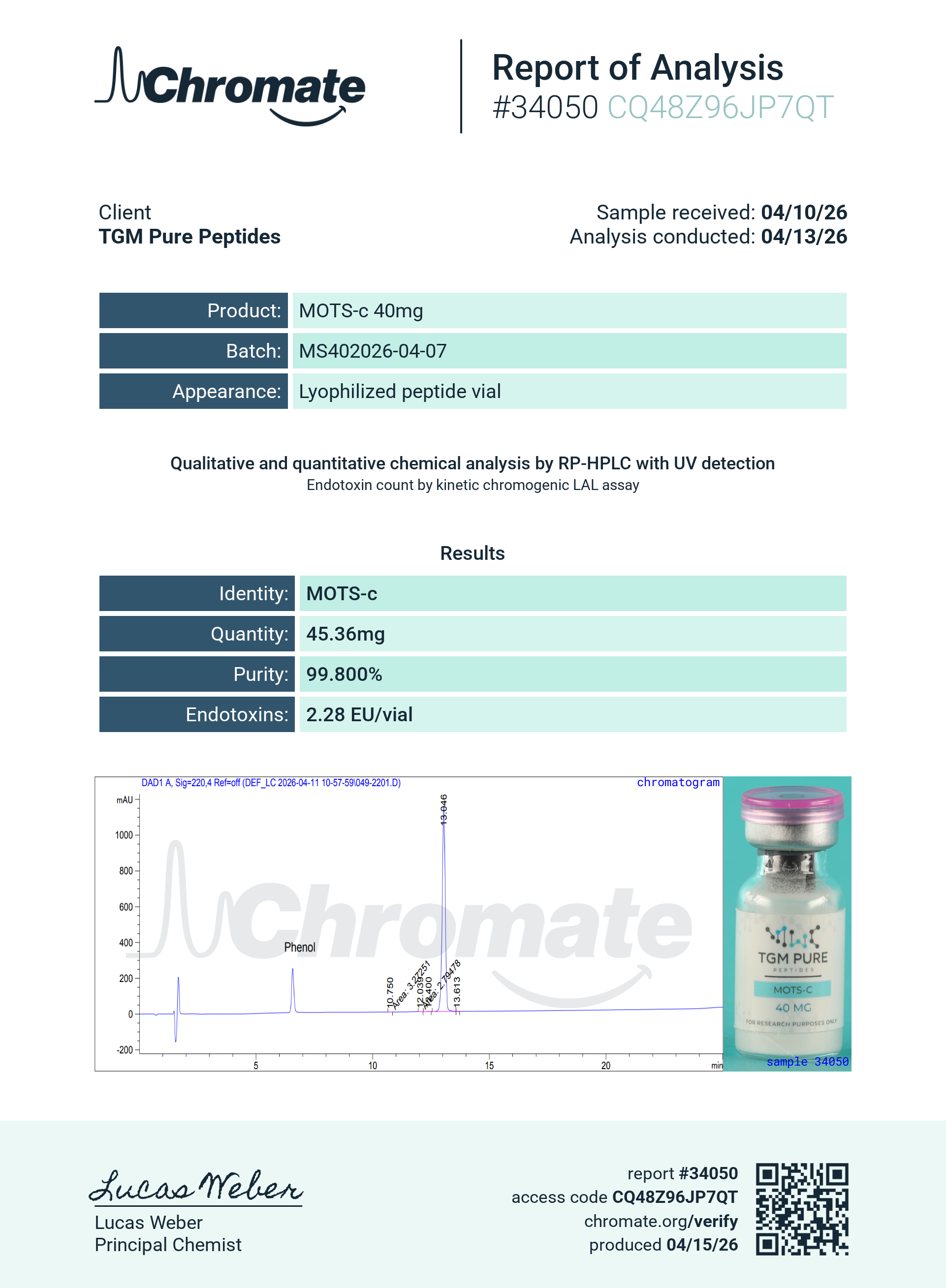
CURRENT BATCH LOT NUMBER: MS402026-04-07
CERTIFICATE OF ANALYSIS – TGMPURE MOTS-C 40 MG (MS402026-05-04)
Mots‑C (Mitochondrial ORF‑of‑the‑twelve‑S‑rRNA‑type‑c) is a 16‑amino‑acid mitochondrial‑derived peptide (MDP) encoded within the mitochondrial 12S rRNA gene. Discovered in 2015, Mots‑C represents a new class of mitochondrial signaling molecules that regulate metabolism, stress adaptation, and cellular homeostasis. Unlike traditional peptides encoded in nuclear DNA, Mots‑C is produced in mitochondria and can translocate to the nucleus under stress, where it influences gene expression related to metabolism, inflammation, and longevity pathways.
Modern research highlights Mots‑C’s ability to enhance insulin sensitivity, promote fat oxidation, improve exercise capacity, and regulate AMPK activation, a central metabolic switch. Mots‑C also plays a role in stress resilience, protecting cells from metabolic dysfunction and inflammatory damage. Early human studies suggest potential benefits in age‑related metabolic decline.
Mots‑C supports metabolic flexibility, mitochondrial function, and stress resilience, making it a promising candidate in longevity and metabolic‑health research. Its mitochondrial origin sets it apart as a unique regulator of whole‑body energy balance.
QUANTITY: 40 MG