FREE SHIPPING ON ORDERS OVER $300 – PLUS A FREE GIFT WITH PURCHASE AS THANKS FOR YOUR SUPPORT

$105.00
GH pulsatility enhancement (GHRH + GHS synergy)
Lean‑mass support & body‑composition improvements
Musculoskeletal recovery & connective‑tissue support
Bone metabolism & osteoblastic activity
Metabolic flexibility & lipid regulation
Age‑related GH/IGF‑1 decline
Sleep quality & circadian rhythm support
CJC‑1295 (without DAC)
Stimulates GHRH receptors in the pituitary
Enhances physiologic GH pulsatility
Supports IGF‑1 elevation through natural GH signaling
Avoids continuous GH elevation associated with exogenous GH therapy
Ipamorelin
Selectively activates GHS‑R1a (ghrelin receptor)
Triggers GH release with minimal cortisol, prolactin, or ACTH impact
Supports recovery, lean‑mass development, and neuroendocrine balance
Combined Effect
Dual stimulation of GH axis (GHRH + GHS synergy)
Amplified physiologic GH pulses
More natural IGF‑1 elevation
Reduced endocrine spillover compared to older secretagogues
This blend is composed of research‑grade peptides and is not FDA‑approved for therapeutic, anti‑aging, or performance use. Most available data come from preclinical studies and early‑stage research. Even so, the combination has gained significant interest in wellness, performance, and endocrine‑focused research communities, supported by substantial anecdotal reporting. While more large‑scale studies are needed, the blend’s dual‑pathway selectivity and promising early findings continue to drive scientific and community interest in GH‑modulating peptide research.
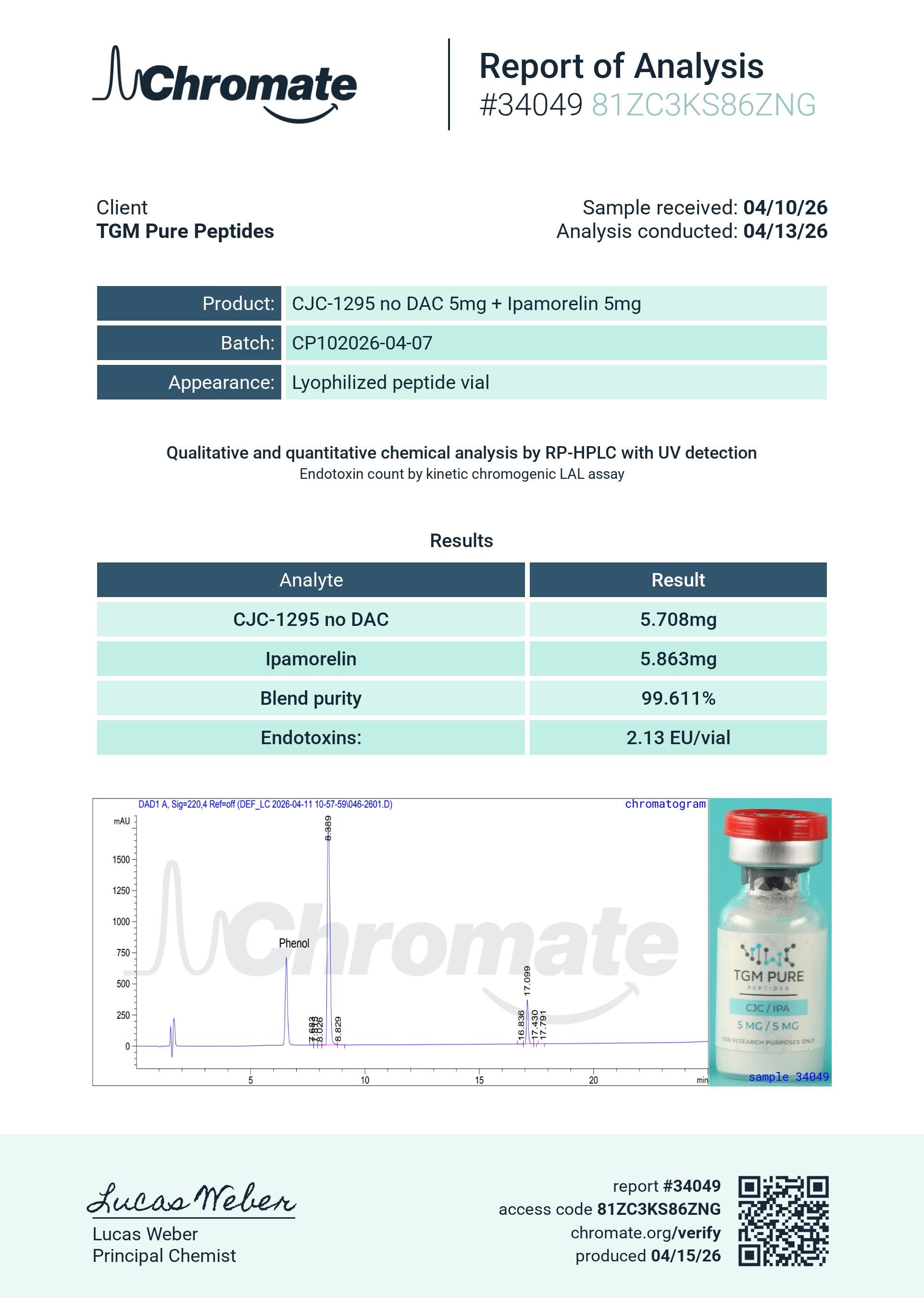
CURRENT BATCH LOT NUMBER: CP102026-04-07
CERTIFICATE OF ANALYSIS – TGMPURE CJC-1295 IPAMORELIN BLEND 10 MG (CP102026-04-07)
A CJC‑1295 + Ipamorelin blend combines two complementary growth hormone–modulating peptides:
Together, these peptides target two distinct but convergent regulatory nodes of the GH axis: hypothalamic GHRH signaling (CJC‑1295) and ghrelin‑mediated pituitary stimulation (Ipamorelin). This dual approach is designed to amplify physiologic GH pulsatility, support IGF‑1 elevation within a more natural rhythm, and minimize the endocrine “spillover” seen with older GHS compounds. Both remain research peptides (outside specific clinical contexts) and are not broadly FDA‑approved for anti‑aging or performance indications.
A CJC‑1295 + Ipamorelin blend leverages dual GH‑axis stimulation—GHRH and ghrelin pathways—to enhance physiologic GH pulsatility and IGF‑1 levels, supporting body composition, recovery, and metabolic research with a more selective endocrine profile than older secretagogues.
QUANTITY: 10 MG (5 MG CJC-1295 + 5 MG IPAMORELIN)